
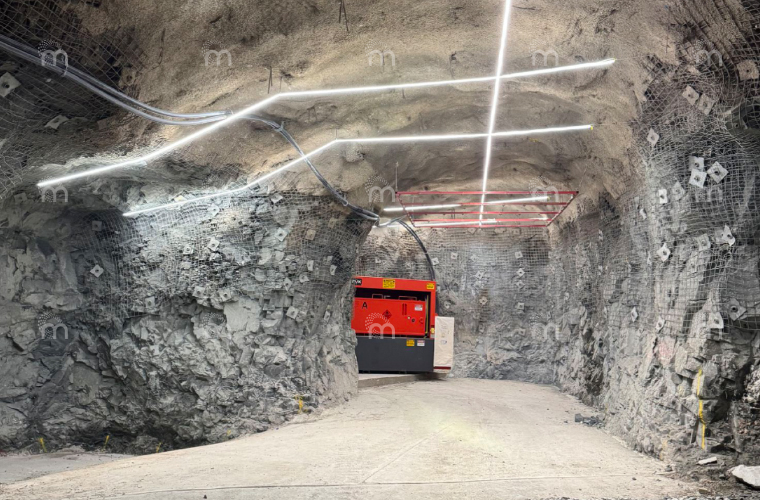
In a classified sewage tunnel under IECEx, lighting must be certified to the zone, gas group, and temperature class of the specific location. Most sewage tunnels and pump station wet wells are Zone 1 for methane and hydrogen sulphide, requiring IECEx certified equipment at gas group IIB minimum and Equipment Protection Level Gb.
Most people specifying lighting for a sewage tunnel start in the wrong place. They search for explosion proof lighting, find a product with an IECEx mark on it, and assume the job is done. It is not. An IECEx certification mark on a product tells you almost nothing on its own. What matters is whether the specific certification covers the zone, the gas group, and the temperature class of the actual location you are installing in.
Get this wrong and you have either installed a product that is not rated for the environment it sits in, which is a safety and compliance failure, or you have over-specified and paid for protection levels the installation does not require. Both outcomes happen regularly in sewage and wastewater infrastructure, and both are avoidable with a working understanding of how the IECEx classification system applies to these environments.
This article works through exactly what is required, starting from the gases present in a sewage tunnel, through how those gases determine the zone classification, and ending with the specific certification criteria that a lighting product must meet to be genuinely compliant in that space.
What Gases Are Present in a Sewage Tunnel and Why They Determine Everything
The starting point for any hazardous area lighting specification is understanding what flammable substance is present and at what concentration. In sewage infrastructure, two gases are relevant: methane and hydrogen sulphide.
Methane (CH4)
Methane is produced by anaerobic digestion of organic matter in raw sewage. It is lighter than air and will accumulate at the highest points of a tunnel, including the crown of a gravity sewer and the roof space of a pump station. Its explosive range in air is 5 to 15 percent by volume. Below 5 percent it will not ignite. Above 15 percent there is insufficient oxygen to sustain combustion. Within that range, a single ignition source is enough to trigger an explosion.
In gravity sewers and rising mains under normal operating conditions, methane concentrations typically fall within Zone 1 or Zone 2 classification, depending on ventilation and flow conditions. In pump station wet wells, where gas accumulates with limited air movement, Zone 1 is the standard classification for most Australian and UK water utilities.
Hydrogen Sulphide (H2S)
Hydrogen sulphide is generated in raw sewage under anaerobic conditions. It is heavier than air and will settle in low points, depressions, and areas of poor ventilation within the tunnel structure. Its explosive range in air is 4 to 44 percent by volume. It is simultaneously toxic at much lower concentrations than those required for ignition, which means H2S presents both a poison risk and a flammable gas risk.
SA Water’s own engineering standard TS0376 notes that while H2S concentrations in most wastewater network sections are generally below levels required for an explosive atmosphere on their own, when combined with methane in anaerobic digestion processes the cumulative gas environment can be explosive. The combination of both gases in a confined tunnel environment is the reason zone classification is required at all.
Key fact: Methane gas group is IIA under IEC 60079 classification. The hydrogen sulphide gas group is IIB. When both are present, the gas group of the more demanding substance applies. Most sewage tunnel specifications use IIB as the minimum gas group requirement to cover both gases present.
How Zone Classification Works in Sewage Tunnels
Zone classification defines how frequently an explosive atmosphere is likely to be present in a given location. The three zones for gas atmospheres under the IEC 60079 series, adopted in Australia as AS/NZS 60079.10.1 and in the UK under BS EN 60079-10-1, are:
- Zone 0: An explosive atmosphere is present continuously or for long periods. In sewage infrastructure this is rare but can apply inside sealed vessels with continuous gas generation, such as the headspace of an anaerobic digester tank. Standard LED strip lighting, even certified Ex, is generally not appropriate for Zone 0 without specific Ga EPL certification.
- Zone 1: An explosive atmosphere is likely to occur occasionally during normal operation. This is the classification that applies to most pump station wet wells, gravity sewer access chambers with poor ventilation, and the lower sections of large diameter sewage tunnels where gas can accumulate. Zone 1 requires equipment certified to EPL Gb (Equipment Protection Level Gas b) as a minimum.
- Zone 2: An explosive atmosphere is not likely to occur in normal operation but may occur under abnormal conditions and will persist for only a short time. This classification applies to areas adjacent to Zone 1 spaces, including the upper sections of ventilated sewage tunnels, access shafts, and areas around manhole openings. Zone 2 requires equipment certified to EPL Gc as a minimum, though Gb-rated equipment can also be used in Zone 2.
The zone for a specific location within a sewage tunnel is not a generic determination. It must be assessed by a competent person based on the source, grade, and rate of release of the flammable gas, ventilation conditions, and operational patterns of the specific installation. What applies to one section of a tunnel does not automatically apply to another section of the same tunnel with different ventilation or flow characteristics.
Typical Zone Classifications in Sewage and Wastewater Infrastructure
The table below reflects the typical zone classifications published in industry guidance for common sewage infrastructure environments. These are indicative starting points. A qualified hazardous area assessor must confirm the classification for each specific installation.
Location | Typical Zone | Primary Gas | Notes |
Pump station wet well (enclosed, poor ventilation) | Zone 1 | CH4 and H2S | Standard Zone 1 classification for most enclosed wet wells in Australia and UK |
Pump station wet well (good mechanical ventilation) | Zone 1 or 2 | CH4 and H2S | Ventilation rate and design affects zone boundary; requires site assessment |
Gravity sewer tunnel (large diameter, flowing sewage) | Zone 1 | CH4 and H2S | Gas accumulates at crown; Zone 1 classification common for enclosed access chambers along the route |
Ventilated sewer access shaft | Zone 2 | CH4 and H2S | Fresh air dilution reduces frequency; Zone 2 may apply to upper shaft above flowing sewage level |
Anaerobic digester headspace | Zone 0 | CH4 (high concentration) | Continuous explosive atmosphere; Zone 0 classification; requires Ga EPL and intrinsically safe protection |
Area adjacent to wet well or sewer entry point | Zone 2 | CH4 and H2S | Transition zone; less frequent gas presence but certification still required |
Foul air extraction ductwork interior | Zone 1 | H2S dominant | Gas concentration within extraction system warrants Zone 1 classification |
Odour control unit (OCU) enclosure | Zone 1 or 2 | H2S | Depends on inlet gas concentration and enclosure design; assess individually |
What IECEx Certification Actually Requires for Sewage Tunnel Lighting
Once the zone is determined, four technical parameters must be matched between the classification of the location and the certification of the lighting product. All four must be correct. One mismatch is a compliance failure.
1. Equipment Protection Level (EPL)
The EPL is the fundamental safety rating of the product. For gas environments, the three EPLs are Ga (Zone 0, 1, or 2), Gb (Zone 1 or 2), and Gc (Zone 2 only). For most sewage tunnel and wet well applications classified Zone 1, the minimum required EPL is Gb. A product marked only Gc is not compliant for Zone 1. A product marked Ga is compliant for Zone 0, 1, and 2.
The EPL appears in the Ex marking on the product label. In a typical marking such as Ex mb IIB T4 Gb, the Gb at the end is the EPL. This tells you the product is certified for Zone 1 and Zone 2 gas environments.
2. Protection Type (Ex Code)
The protection type is the engineering method used to prevent the lighting product from becoming an ignition source. For LED strip lighting in sewage tunnels, the most relevant protection types are:
- Ex mb (encapsulation, level b): The electrical components are embedded within a compound that prevents ignition of the surrounding atmosphere. This is the protection type used in MineGlow’s SafeGlo EXm LED strip range. The mb suffix indicates EPL Gb suitability, meaning Zone 1 and Zone 2 compliance. IEC 60079-18 governs this protection method.
- Ex d (flameproof enclosure): The enclosure can contain an internal explosion and prevent it from propagating to the surrounding atmosphere. Common in traditional point-source explosion proof fittings. Not typically used in LED strip format due to physical constraints.
- Ex e (increased safety): Measures are applied to prevent the generation of sparks, arcs, or excessive temperatures under normal and specified abnormal conditions. Can be used for terminal boxes and connections but not typically as the primary protection method for lighting in Zone 1.
- Ex i (intrinsic safety): The electrical circuit is limited to energy levels below those that can ignite the gas. Used in Zone 0 applications where Ex ia is required. Not the standard approach for continuous tunnel lighting systems.
3. Gas Group
The gas group matches the product certification to the most demanding flammable substance present in the location. For sewage environments, the relevant groups are IIA (methane, propane) and IIB (hydrogen sulphide, ethylene). Since H2S falls in group IIB and is present in most sewage tunnels alongside methane (group IIA), the minimum gas group requirement for sewage tunnel lighting is IIB.
A product certified for gas group IIA only is not compliant in a location where IIB gases are present. A product certified for IIB covers both IIA and IIB gases. A product certified for IIC covers all three groups. For sewage tunnel applications, IIB certification is the accepted minimum. IIC provides additional coverage but is not mandatory unless the specific gas risk assessment identifies IIC substances.
Gas group quick reference for sewage tunnels: Methane (CH4): Gas Group IIA. Hydrogen sulphide (H2S): Gas Group IIB. Sewage tunnel minimum requirement: Gas Group IIB (covers both gases present). A product marked IIA only is not suitable for locations where H2S may be present.
4. Temperature Class (T Rating)
The temperature class specifies the maximum surface temperature the product will reach during operation. The surrounding gas must not be ignited by contact with a hot surface. The ignition temperature of methane is 537 degrees Celsius and the ignition temperature of hydrogen sulphide is 260 degrees Celsius. The temperature class of the lighting product must be below the ignition temperature of the most sensitive gas present.
For sewage tunnels where H2S is the controlling gas at 260 degrees Celsius, a T3 rating (maximum surface temperature 200 degrees Celsius) is the practical minimum. T4 (135 degrees Celsius maximum) provides additional safety margin and is the standard specification for most sewage tunnel lighting. T5 and T6 are also acceptable but are not required unless higher-temperature-sensitivity gases are identified in the hazardous area assessment.
T Class | Max Surface Temp | Ignition Temp of H2S | Suitable for Sewage Tunnels? |
T1 | 450 degrees C | 260 degrees C | No. Surface temp exceeds H2S ignition temp |
T2 | 300 degrees C | 260 degrees C | No. Surface temp exceeds H2S ignition temp |
T3 | 200 degrees C | 260 degrees C | Yes. Surface temp below ignition temp of H2S with margin |
T4 | 135 degrees C | 260 degrees C | Yes. Standard for most sewage tunnel specifications |
T5 | 100 degrees C | 260 degrees C | Yes. More conservative; used where additional margin required |
T6 | 85 degrees C | 260 degrees C | Yes. Maximum conservatism; required for higher-sensitivity gases not typical in sewage |
How to Read an IECEx Certification Mark on Sewage Tunnel Lighting
Every IECEx certified product carries a marking string that encodes all four parameters above. Understanding how to read it is essential for specifying and verifying compliance. Here is a worked example using MineGlow’s SafeGlo EXm certification:
Example marking: Ex mb IIB T4 Gb | IECEx TSA 21.0013X
- Ex: Prefix confirming this is explosion protected equipment certified to IEC 60079 standards.
- mb: Protection type. Encapsulation to level b, governed by IEC 60079-18. The b suffix confirms EPL Gb suitability.
- IIB: Gas group. Covers IIA gases (methane) and IIB gases (hydrogen sulphide). Correct for sewage tunnel environments.
- T4: Temperature class. Maximum surface temperature 135 degrees Celsius. Below the ignition temperature of H2S at 260 degrees Celsius. Compliant for sewage tunnel use.
- Gb: Equipment Protection Level. Certified for Zone 1 and Zone 2 gas environments. Compliant for most sewage tunnel and pump station wet well applications.
- IECEx TSA 21.0013X: The IECEx certificate number. TSA indicates certification body (Testing Services Australia). This number can be verified directly on the IECEx public certificate database at iecex.com to confirm scope, product model, and certification status.
Any product installed in a classified sewage tunnel should have its certification number verified against the IECEx database before installation. A product with an expired certificate, a certificate that does not cover the specific model installed, or a certificate that was issued for a different protection scope is not compliant regardless of what the product label shows.
Important: An IECEx certificate number alone is not sufficient verification. The certificate must be checked on the IECEx public database to confirm it is current, covers the exact product model and variant being installed, and that the scope includes the zone, gas group, and temperature class required for your installation.
The Most Common Specification Errors in Classified Sewage Tunnel Lighting
SERP research and conversations with water utility engineers reveal the same errors appearing repeatedly. Each represents a real compliance risk.
Installing Zone 2 rated equipment in a Zone 1 location
A product marked Gc or Zone 2 only cannot be used in a Zone 1 classified area. This is the single most common compliance error in sewage tunnel lighting. The EPL on the product certification must match or exceed the zone of the installation. Gc is not compliant for Zone 1. Gb or Ga is required.
Specifying gas group IIA where IIB is required
A product certified for gas group IIA covers methane but does not cover hydrogen sulphide, which is gas group IIB. In any sewage environment where H2S may be present, IIA certification is insufficient. Many standard explosion proof products are certified to IIA because it covers the most common industrial gas applications. Always verify the gas group against the specific gases present, not a generic assumption.
Assuming standard IP67 LED strip is suitable
IP rating and IECEx certification are completely separate requirements. An LED strip rated IP67 is sealed against water and dust ingress. It is not certified for use in explosive atmospheres. Installing a standard IP67 LED strip in a classified sewage tunnel is non-compliant regardless of how well it is sealed against water. The two certifications address different risks and neither replaces the other.
This is a distinction that deserves emphasis. Water utilities familiar with MineGlow’s standard x-Glo IP67 LED strip range sometimes assume it is suitable for classified sewage areas. It is not. The standard x-Glo is the correct product for non-classified water tunnels including fresh water infrastructure. For classified zones, the SafeGlo EXm range with its IECEx Gb certification is the required specification.
Not verifying the certificate before installation
A certificate number on a data sheet is not the same as a verified, current certificate. Certificates can expire, be withdrawn, or be issued for a different model variant than the one supplied. The IECEx public database allows verification of any certificate number in real time. Making this check a mandatory step in the procurement and installation process is the only way to confirm that what is installed is what is certified.
Sewage Tunnel Lighting Specification Checklist Under IECEx
Before specifying any lighting for a classified sewage tunnel, work through the following steps in order. Each feeds into the next.
1. Confirm the hazardous area classification.
A qualified hazardous area assessor must determine the zone (0, 1, or 2) for each specific location within the tunnel. Do not apply a generic zone to the whole tunnel without assessment.
2. Identify the gases present and determine the gas group.
For sewage tunnels, identify whether methane only (IIA) or methane and hydrogen sulphide (IIB) are present. Specify IIB as the minimum gas group unless a gas risk assessment confirms only IIA substances are relevant.
3. Determine the required temperature class.
For H2S environments, T3 is the minimum acceptable temperature class. T4 is the standard specification for most sewage tunnel lighting applications.
4. Select the protection type appropriate for the zone and fixture format.
For Zone 1 LED strip lighting, Ex mb (encapsulation) with EPL Gb is the protection type used in certified products including MineGlow’s SafeGlo EXm. Confirm the protection type matches the zone requirement.
5. Verify IP rating separately.
Classified sewage tunnels are also wet and corrosive. Confirm the product carries IP67 as a minimum alongside its IECEx certification. IECEx certification and IP rating are separate requirements and must both be confirmed.
6. Verify the IECEx certificate on the public database.
Enter the certificate number at iecex.com. Confirm it is current, covers the exact model and variant being installed, and that the scope matches the zone, gas group, and temperature class required.
7. Document the specification and retain the certificate.
Maintain records of the zone assessment, the product certification, the installation date, and the certificate verification. These records are required in the event of an audit, safety review, or incident investigation.
Applying This in Practice
MineGlow’s SafeGlo explosion proof LED strip lighting range was developed specifically to address the gap between standard IP67 industrial LED strips and the certified explosion proof requirement in classified water utility and sewage infrastructure. It holds IECEx certification to Ex mb IIB T4 Gb under certificate IECEx TSA 21.0013X, covering Zone 1 and Zone 2 gas environments with gas group IIB and temperature class T4. It is available in 24V, 36V, and 48V configurations, carries IP67 water ingress protection alongside its IECEx certification.
For water utility engineers and facility managers working through a hazardous area lighting specification for sewage infrastructure in Australia or the UK, the SafeGlo product range contains full certification documentation. MineGlow’s technical team can assist with application-specific specification questions through the project enquiry.
Frequently Asked Questions
These questions represent the most common queries from engineers and safety managers specifying lighting for classified sewage tunnel environments.
Q: Does all sewage tunnel lighting need to be IECEx certified?
Only sections of sewage tunnel that have been formally classified as Zone 0, Zone 1, or Zone 2 hazardous areas require IECEx certified explosion proof lighting. Not all sections of a sewage tunnel are necessarily classified. Access shafts with adequate ventilation and areas away from direct gas sources may be assessed as unclassified. The zone assessment by a competent person determines which sections require certified equipment. Standard LED strip lighting is appropriate for unclassified sections.
Q: Can I use the same IECEx certified product in Zone 1 and Zone 2?
Yes, provided the product carries a Gb or Ga Equipment Protection Level. A product certified to EPL Gb is suitable for both Zone 1 and Zone 2 gas environments. A product certified only to EPL Gc is suitable for Zone 2 only and cannot be installed in Zone 1. Ga certification covers all three zones. Using a Gb-rated product throughout a tunnel that includes both Zone 1 and Zone 2 sections simplifies procurement and removes the risk of installing incorrect products in specific zones.
Q: Is an IP67 LED strip suitable for a classified sewage tunnel?
No. An IP67 rating addresses water and dust ingress. It does not address the risk of the product igniting an explosive atmosphere. These are completely separate certifications covering different risks. A classified sewage tunnel requires both an appropriate IP rating for water and humidity protection and IECEx certification for the explosive atmosphere. Standard IP67 LED strips without IECEx certification are not suitable for installation in classified zones, regardless of how well they are sealed.
Q: What gas group do I need to specify for a sewage pump station wet well?
The minimum gas group for a sewage pump station wet well is IIB. Hydrogen sulphide, which is consistently present in raw sewage pump stations, is a Group IIB gas. Methane is Group IIA, but since IIB certification covers IIA gases, specifying IIB covers both gases present. A product certified only to gas group IIA is not compliant in an environment where H2S may be present. MineGlow’s SafeGlo EXm is certified to gas group IIB, covering the requirements of standard sewage tunnel and wet well applications.
Q: How do I verify an IECEx certificate before installation?
The IECEx public certificate database is available at iecex.com. Enter the certificate number from the product documentation and verify that the certificate is current and not suspended or withdrawn, that it covers the specific product model and variant being installed, that the scope includes the zone, gas group, and temperature class required for your installation, and that the listed manufacturer matches the product supplier. Verification should be done before installation and the result should be documented and retained as part of the installation record.
Q: What is the difference between IECEx and ATEX certification for sewage tunnel lighting?
IECEx is an international certification scheme accepted worldwide, including in Australia. ATEX is the European Union regulatory framework. Both use the same zone classification system and the same IEC 60079 series of standards for testing. In Australia, IECEx certification is the relevant requirement. In the UK, ATEX certification was the mandatory framework while the UK was an EU member state. Post-Brexit, UKCA marking is being phased in for UK installations, though ATEX and IECEx certificates continue to be accepted in practice. MineGlow’s SafeGlo EXm holds both IECEx and ATEX certification, making it compliant for classified sewage tunnel applications in both Australia and the UK.