
Introduction
Underground mining environments present unique safety challenges, particularly in areas where combustible gases, coal dust, explosives storage and limited visibility increase operational risk. While ventilation and monitoring systems are critical, lighting also plays an essential role in maintaining safe working conditions.
Poor illumination can make inspections more difficult, increase the risk of slips and falls, and delay the identification of equipment faults. In hazardous locations, lighting must also be designed to prevent ignition of explosive atmospheres.
Key Insight
The right hazardous area lighting improves safety, supports compliance and helps mining operations work more efficiently.
The risks of poor underground lighting
Hazardous areas in coal mining such as reclaim tunnels, coal wash plants and conveyor systems often operate in conditions where methane gas or combustible dust may be present.
Older lighting systems create uneven illumination, increasing the likelihood of workplace incidents while making maintenance and inspections more difficult. Frequent lamp failures also increase maintenance requirements, exposing personnel to unnecessary risk that results in production downtime.
Choosing the right hazardous area lighting
Lighting used in hazardous environments should be certified for explosive atmospheres and built to withstand harsh mining conditions.
When selecting a lighting solution, look for:
- IECEx or ATEX certification
- Gas Zone 1 and 2 approval
- Dust Zone 21 and 22 approval
- IP65 or IP67 rating
- Corrosion and impact resistant
- High colour rendering (CRI) - Midday Lighting
- Long service life with minimal maintenance
Why LED strip lighting is the preferred solution
Continuous LED strip lighting delivers consistent illumination throughout long underground spaces where conventional fittings often leaves an area in the dark
Compared with traditional lighting, LED systems offer:
- Improved visibility
- Lower maintenance requirements
- Reduced energy consumption
- Longer operating life - 50,000 hours
- More reliable performance in harsh environments - Less than 1% failure rates
These advantages help improve both workplace safety and operational efficiency.
SafeGlo in underground mining
Mineglow’s SafeGlo range is IECEx and ATEX certified for hazardous mining environments, including Gas Zones 1 and 2 and Dust Zones 21 and 22.
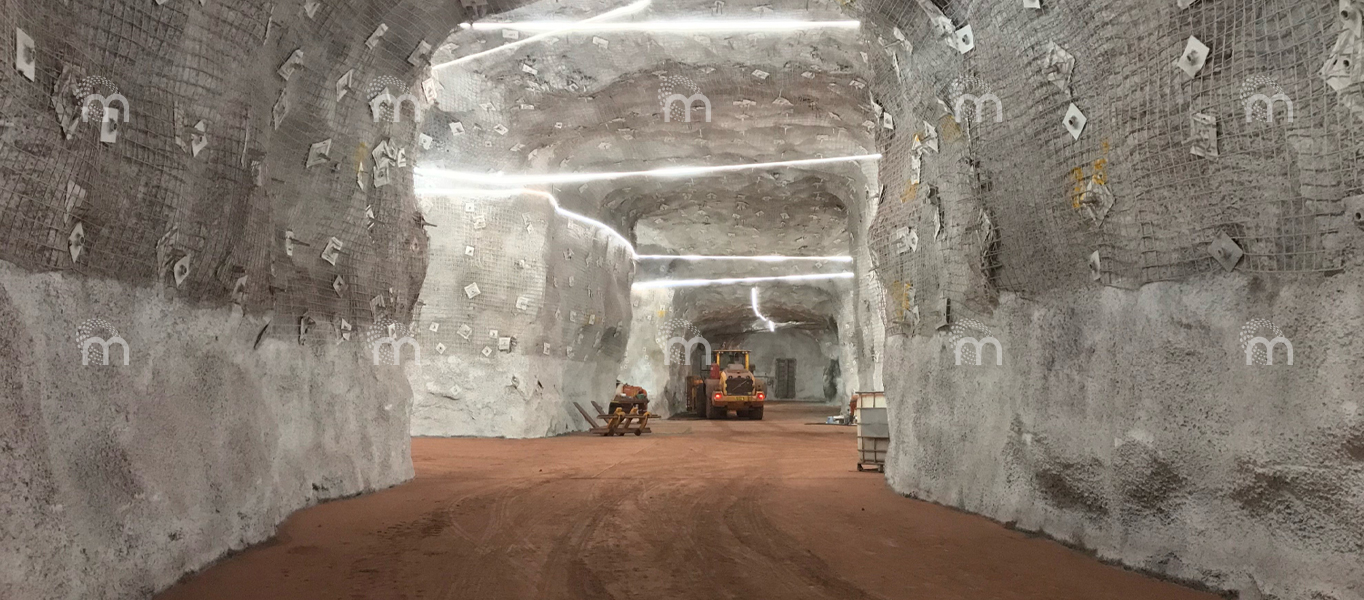
In one Queensland underground coal mine, the installation of the SafeGlo range improved visibility throughout a reclaim tunnel, enabling safer inspections and more efficient maintenance activities. Resulting in less downtime due to lighting issues.
Key Takeaways
- Poor lighting increases safety and maintenance risks underground.
- Certified hazardous area lighting helps reduce ignition risk.
- Continuous LED strip lighting improves visibility and inspection quality.
- Modern LED systems reduce maintenance and energy costs.
- Selecting certified lighting supports safer, more reliable mining operations.
Frequently Asked Questions
Q: Why is hazardous area lighting important in underground mines?
Hazardous area lighting matters because the parts of an underground mine that carry the highest ignition risk are usually the parts that are hardest to see in — and the certification requirement limits what can legally be installed there.
In a classified area, every fitting must be certified for that specific zone, gas or dust group and temperature class. That narrows the available product range considerably. Historically, the only compliant option was a heavy flameproof (Ex d) luminaire, so operations installed fewer of them, spaced further apart, and accepted the result: pools of light separated by shadow, glare from point sources, and dark patches in exactly the locations where the consequences of a mistake are highest.
Certified lighting therefore has to do two jobs, not one:
- Ignition control — the fitting cannot become a source of ignition in a methane or coal dust atmosphere.
- Visual safety — people can see uneven floors, standing water, moving conveyor components, hydraulic leaks, spalling ribs and vehicle movement early enough to react.
A lighting system that satisfies the first requirement but fails the second is still a safety problem. It is compliant and dark. Ex-rated LED strip lighting closes that gap: because it is low profile and continuous, adequate and even light levels can be achieved in areas where a bulky fixture physically cannot be installed at all.
Q: Why do traditional Ex-rated light fittings compromise underground lighting?
Conventional flameproof fittings are bulky, heavy and slow to install, so crews frequently end up installing fewer of them than the space actually needs.
An Ex d luminaire works by containing an explosion inside its own enclosure. That is why it is built the way it is: a thick cast housing, toughened glass, a bolted cover with certified flamepaths, cable glands and a dedicated mounting bracket. Underground, that construction has consequences:
- It needs clearance and a structural mounting point. In a reclaim tunnel, conveyor drift, crusher station, pump chamber or underground fuel bay, that space and steelwork often are not there.
- Installation is slow. Brackets, conduit, glanding and termination at every single fitting — usually a two-person job, frequently at height or inside a confined space permit.
- It is a point source. Illuminance falls away with distance from the fitting, so the space between fittings becomes shadow and the space directly beneath becomes glare.
- Every unit adds inspection burden. Each enclosure is another entry on the Ex register, another gasket and flamepath to inspect and maintain, and another opportunity for loss of Ex integrity.
The practical outcome is a compromised lighting design. The layout gets cut back to what can realistically be mounted and maintained, rather than what the task genuinely requires — which is how hazardous areas end up being the worst-lit areas on site.
Q: How does LED strip lighting improve visibility in underground mines?
Ex-rated LED strip lighting produces one continuous line of light rather than a series of separated point sources, which removes the dark gaps between fittings altogether.
MineGlow’s SafeGlo and x-Glo Ex ranges deliver up to 1,000 lumens per metre at a colour rendering index above 80 and a colour temperature of 6500 K — close to natural daylight. The practical effects underground are:
- No shadow gaps. Illumination is even along the full length of a tunnel, walkway, conveyor run or travel road, so hazard recognition does not depend on where a worker is standing.
- Less glare and less adaptation. Light is distributed across the run rather than concentrated in bright points, so eyes are not constantly readjusting between bright and dark.
- Better inspection quality. High CRI at daylight colour temperature makes it far easier to identify a hydraulic weep, a frayed belt edge, a hot bearing discolouration, a cracked weld or a change in strata condition.
- It follows the structure. The strip mounts along conveyor stringers, arches, cable trays, handrails and walkway edges, so the light goes where the work and the walking route actually are.
- Better camera performance. Uniform lighting improves the usable output of CCTV and remote monitoring systems.
Q: Which areas of an underground mine need hazardous area lighting?
Any location classified as a hazardous area under the site’s hazardous area dossier requires certified lighting. In underground coal and adjacent surface infrastructure, this typically includes:
- Reclaim tunnels and drift conveyors
- Conveyor transfer points, chutes and crusher stations
- Coal handling and preparation plants (CHPP) and wash plants
- Underground fuel bays and refuelling stations
- Underground workshops, magazines and explosives storage
- Pump stations, sumps and dewatering chambers
- Longwall and development panels, and return airways
- Designated egress and travel routes
- Gaseous or dust-affected tunnels in civil and infrastructure projects
Zone classification is site-specific and is determined through the hazardous area classification process (AS/NZS 60079.10.1 for gas, AS/NZS 60079.10.2 for dust). Lighting selection should always follow the classification drawings and dossier for the specific area, not a general assumption about the mine as a whole.
Q: What certification should underground mine lighting have?
Lighting installed in a classified hazardous area must hold IECEx certification (or ATEX, depending on jurisdiction) that matches the zone, the equipment group, the temperature class and the environmental conditions of the installation.
Four things need to line up:
Requirement | What to check |
Equipment group | Group I for underground mining (methane and coal dust). Group II for surface gas atmospheres, Group III for combustible dust. Group I equipment is certified specifically for the mining risk and is not interchangeable with Group II. |
Zone / EPL | Gas Zones 1 and 2, dust Zones 21 and 22, and equipment protection levels Mb, Gb or Db for underground mining applications. |
Temperature class | The maximum surface temperature of the fitting must be below the ignition temperature of the gas or dust present (for example, T6, or T80°C for dust). |
Ingress and environment | IP rating, operating temperature range, impact and corrosion resistance appropriate to the location. |
MineGlow’s Ex ranges are certified under:
- Queensland mining specific — IECEx TSA 21.0013X
- Australia and rest of the world — IECEx TPS 19.0047X (mining, oil and gas and other industrial hazardous areas)
Markings include Ex ma I Mb, Ex mb I Mb, Ex mb IIC T6 Gb and Ex mb IIIC T80°C Db, covering Zones 1/21 and 2/22.
Certificates can be verified independently on the IECEx Online Certification System at iecex-certs.com. Requesting the certificate number, not just a claim of certification, is good practice for any hazardous area purchase.
Q: What does an Ex marking like "Ex mb IIC T6 Gb" actually mean?
Each element of an Ex marking describes a specific aspect of how the equipment is protected. Reading Ex mb IIC T6 Gb left to right:
- Ex — certified explosion-protected equipment.
- mb — the protection technique is encapsulation, at protection level “b”. Ignition-capable components are permanently embedded in a compound so an explosive atmosphere cannot reach them.
- IIC — suitable for Group IIC gas atmospheres, the most demanding gas group (hydrogen and acetylene).
- T6 — maximum surface temperature does not exceed 85 °C.
- Gb — equipment protection level for gas atmospheres, suitable for Zone 1 and Zone 2.
The “m” in that marking is the reason strip lighting can be Ex certified at all. Encapsulation protects by sealing the electronics rather than by containing an explosion inside a heavy enclosure, so the fitting does not need a cast housing, a flamepath or a bolted cover. That is what allows a certified light source to be a low-profile, flexible, continuous strip instead of a rigid box and it is the underlying technical reason Ex-rated LED strip can be installed where a flameproof fixture cannot.
Q: Can hazardous area LED lighting withstand underground mining conditions?
Yes, provided it is engineered for the environment rather than adapted from a general-purpose product.
MineGlow’s SafeGlo Ex-rated LED strip lighting is fully encapsulated in silicone to IP67, with a tensile strength of 100 kg and an operating range of −30 °C to 80 °C. Because the light source is sealed within the encapsulation, there is no glass to break, no lamp to replace, no gasket to perish and no enclosure seal to compromise. That construction directly addresses the failure modes that shorten fixture life underground:
- Dust and water ingress — full encapsulation with dust and dirt retardant technology, rather than a sealed cavity that depends on gasket condition.
- Vibration — no filament, no lamp holder and no rigid glass envelope, which removes the components that vibration usually kills first.
- Impact and abrasion — flexible silicone absorbs strikes from equipment, ribs and material spillage that would crack a glass lens.
- Temperature and humidity swings — no internal air volume to condense moisture as the strip heats and cools.
Expected output degradation is approximately 20% over four years, with a 5-year warranty and a service life of up to 10 years.
Q: How can LED lighting reduce maintenance in underground mines?
The largest maintenance saving is not the cost of lamps — it is the reduction in how often people have to enter a hazardous or difficult location to fix a light.
Ex-rated LED strip lighting requires no routine maintenance unless it is physically damaged. Compared with conventional fittings:
- No lamp replacement cycle. There is no consumable lamp, starter or ballast to schedule and change out.
- Fewer exposures. Every avoided lamp change is one less confined space entry, work-at-height task, isolation, permit and conveyor shutdown.
- Fewer Ex integrity checks. A continuous encapsulated run replaces dozens of individual enclosures, each of which would otherwise carry its own inspection and flamepath maintenance obligation.
- Localised repair. Damaged sections can be repaired in place using repair kits and connectors rather than replacing an entire fitting or run.
- Less downtime. MineGlow reports field failure rates below 1% across its installed base, which translates directly into fewer unplanned lighting-related interruptions.
In one Queensland underground coal mine, installing the SafeGlo range through a reclaim tunnel improved visibility for inspections and maintenance while reducing downtime caused by lighting faults.
Q: Does hazardous area LED lighting reduce energy use and emissions?
Yes, on three fronts: consumption, replacement volume and transport.
At 6 to 12 watts per metre, an Ex-rated LED light strip draws substantially less power than the fluorescent and discharge fittings it typically replaces, which matters underground where lighting load adds to ventilation and cooling demand. A service life of up to 10 years with negligible routine maintenance also reduces the volume of failed fittings, lamps and packaging that has to be transported in and waste removed from site over the life of an installation.
The SafeGlo hazardous light is the ONLY LED strip to hold an Environmental Product Declaration (EPD) for its LED strip lighting, which provides independently verified, life-cycle-based environmental data. For operations reporting against sustainability or Scope 3 targets, an EPD gives auditable figures rather than general environmental claims — and it is increasingly requested during tender and procurement evaluation.
Build a Safer, More Sustainable Workplace with Better Lighting
Lighting plays a vital role in creating safer, more efficient industrial environments. From improving visibility and reducing maintenance to supporting sustainability goals and Zero Harm initiatives, the right lighting solution delivers benefits that extend well beyond illumination.
If you’re upgrading an existing facility or specifying lighting for a new project, Mineglow’s industrial LED strip lighting is engineered to perform in the toughest conditions. Our team works with mining, tunnelling, oil and gas, utilities and heavy industry operators to recommend reliable lighting solutions tailored to each application.