
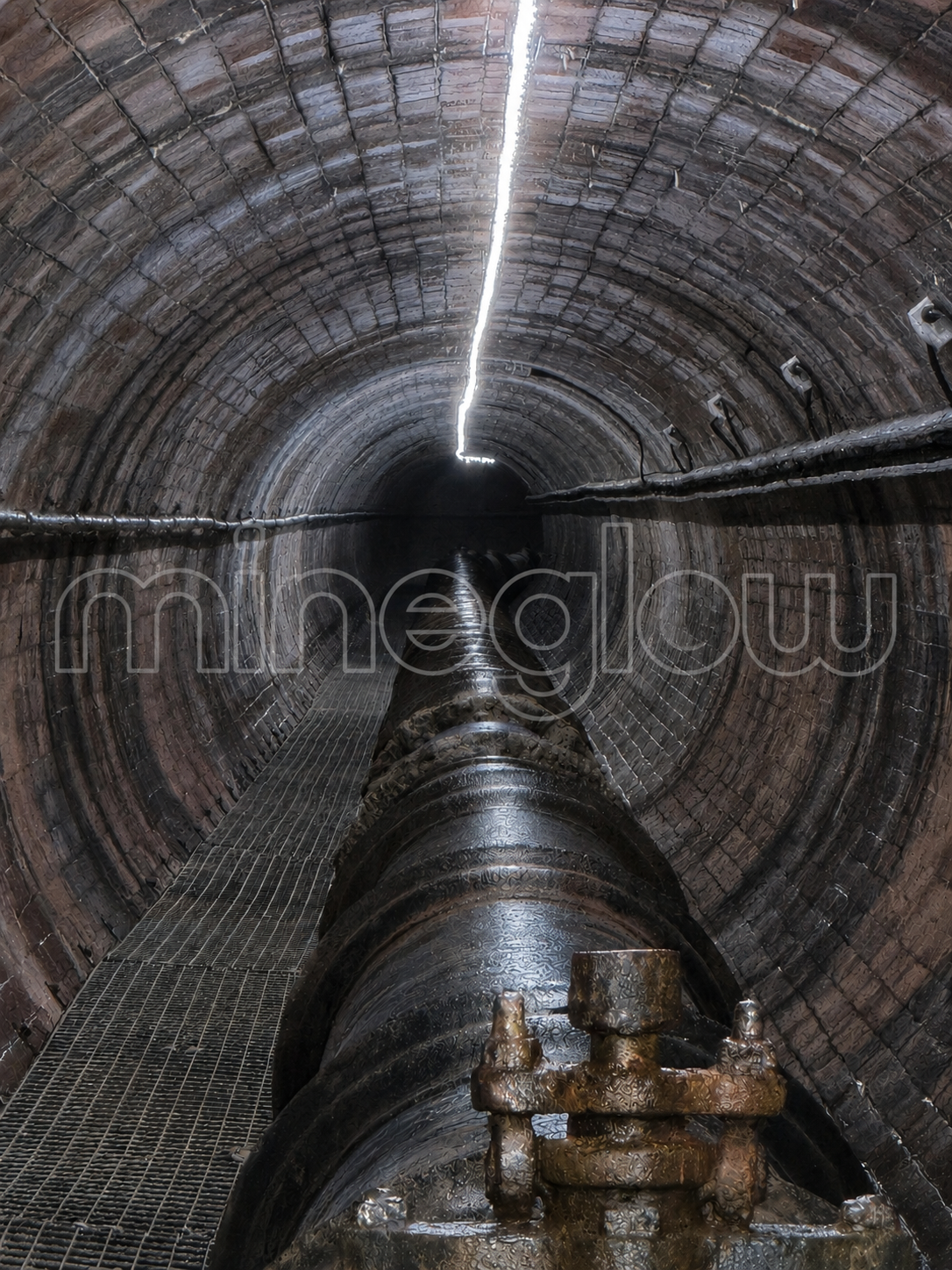
Quick Answer: Why Are Water Utilities Replacing Conventional Lighting with LED Strip Lights?
Water utilities are replacing conventional lighting with LED strip lights in tunnels and reservoirs for four primary reasons:
- Conventional lights fail as individual units, making each repair a costly confined space operation. In UK water tunnels, a single repair can require a dive team on standby, costing approximately £2,000 per day.
- LED strip lights are wired in parallel circuits. If one section fails, the rest of the system keeps working. The maximum section that can fail at any one time is 10 centimetres, making LED strips 670 times less likely to cause a significant lighting failure than a conventional fitting.
- LED strip systems consume 70 to 90 per cent less electricity than conventional lighting and last over 50,000 hours under continuous operation, compared to 1,000 to 2,000 hours for traditional lamps.
- LED strip lighting installs directly onto existing tunnel walls, ceilings, and frameworks, runs up to 400 metres between power sources, and can be cut on site to any length from 10 centimetres upward.
There is a light fitting somewhere in a water tunnel right now that nobody can easily replace. It failed weeks ago. The section it covers sits in partial shadow. And the maintenance team knows full well that fixing it means coordinating a confined space entry permit, a ventilation crew, and in many cases, a dive team on standby. In the UK, that dive team alone costs around £2,000 per day.
This is not an edge case. It is how lighting maintenance works across water networks that rely on conventional lighting systems, specifically spot fittings and linear fluorescents bolted to ceilings inside tunnels, reservoirs, pump stations, and dam walls that were designed and built decades ago. Replacing a single failed light is never just replacing a light. It is a logistics exercise that consumes budget, time, and safety resources that water utilities simply do not have in abundance.
This is why the shift toward LED strip lighting is accelerating across water infrastructure in Australia, the UK, and beyond. It is not being driven by enthusiasm for new technology. It is being driven by the operational reality of ageing infrastructure, increasing pressure on maintenance budgets, tighter regulatory requirements around worker safety, and a growing demand for energy efficiency across critical infrastructure.
Definition: LED strip lighting is a continuous, flexible circuit board embedded with light-emitting diode (LED) chips, encased in a protective PVC or silicone extrusion. Industrial-grade LED strips are rated IP67 or higher for waterproof and dustproof performance, and are wired in parallel so individual LED failures do not interrupt the full run.
The Problem with Conventional Lighting in Water Infrastructure
Water utilities operate in some of the most demanding environments for lighting. Underground tunnels carrying fresh water, reservoir access passages, dam wall inspection corridors, hydro plant galleries, and sewage systems all share common characteristics: they are wet, confined, often corrosive, and difficult to access. Conventional lighting was never engineered with these environments in mind.
Traditional spotlights and fluorescent tubes are mounted as individual units, each with its own housing, driver, and power connection. In a standard above-ground facility, replacing one when it fails is straightforward. Inside a live water tunnel, it is anything but. Access often requires a confined space entry procedure under current safety standards. If the tunnel is submerged or partially flooded, a dive team must be on site and on standby before any work can begin, regardless of whether they are needed. The cost of that standby cannot be avoided.
The result is a structurally expensive maintenance model. Water utilities across Australia and the UK have reported that when conventional lights fail in live tunnels and reservoirs, repairs are often deferred until multiple fittings have failed. The logic is straightforward: if you are going to incur the full cost of a confined space entry and dive team standby, you need to make it worth the disruption. So individual failures accumulate. Sections of the tunnel fall into poor lighting conditions. Worker visibility drops. The risk of a safety incident increases, and the pressure on maintenance budgets grows.
Australia’s water infrastructure adds another layer of complexity. Infrastructure Australia’s 2019 Audit identified water and wastewater systems among the country’s most ageing public assets. The Bureau of Meteorology’s National Performance Report 2023-24 recorded a median of more than 12.7 water main breaks per 100 kilometres of pipe per year. These are networks under sustained operational pressure, often with limited funding for proactive upgrades. The UK faces similar challenges, with billions of litres of water lost through leaky infrastructure daily and significant investment backlogs in ageing pipe networks across England and Wales.
LED Strip Lighting vs Conventional Lighting in Water Infrastructure: Side-by-Side Comparison
The table below summarises the key differences between industrial LED strip lighting and conventional lighting systems (spot lights, fluorescent tubes, HPS lamps) when deployed in underground water utility environments.
| Criteria | LED Strip Lighting | Conventional Lighting |
| Service lifespan | 50,000+ hours (10+ years continuous) | 1,000–2,000 hours (months to 1 year) |
| Failure model | Parallel wiring: max 10cm fails at one time; the rest of the strip operates normally | Single unit failure: the full fitting goes dark when it fails |
| Failure risk vs conventional | 670x less likely to cause a significant lighting failure | Baseline: individual failure affects the entire fitting area |
| Energy consumption | 70–90% less electricity than incandescent; significantly less than fluorescent/HPS | High: fluorescent and HPS are significantly less efficient |
| Maintenance model | Planned: failures deferred safely; small sections repaired on site | Reactive: each failure requires urgent confined space entry |
| Maintenance cost impact | 40–60% reduction in overall lighting maintenance costs | 30–40% of total lighting costs are consumed by maintenance over installation life |
| Water/dust protection | IP67 rated as standard, fully sealed against water ingress and dust | Variable: Many standard fittings are not suited to high-humidity tunnel environments |
| Illumination quality | Continuous, shadow-free illumination along the full tunnel length | Spot-based: dark zones between fittings; shadows at fixture spacing |
| Power run length | Up to 400m between power sources (48V tunnel range) | Individual fitting: power connection required at each luminaire location |
| Installation onto existing structures | Attaches directly to tunnel walls, ceilings, and catenary wires with minimal cabling | Requires mounting brackets, conduit, and individual power drops per fitting |
| Explosion-proof option | Yes: IECEx/ATEX certified SafeGlo EXm range for sewage, wastewater, hazardous zones | Available but typically bulky point fixtures; not a continuous strip format |
| Temporary use | Yes: magnetic mount installation in minutes for maintenance operations | Not practical: requires fixed mounting and wiring |
| Heat output | Minimal: LEDs produce little to no heat, reducing cooling requirements | Significant: fluorescent and HPS lamps generate substantial heat |
| Environmental impact | Lower carbon footprint; no hazardous substances; supports net-zero targets | Higher carbon footprint; many conventional lamps contain hazardous substances |
Why LED Strip Lighting Changes the Equation
LED strip lighting approaches the problem from a completely different direction. Rather than a series of individual fittings that each fail independently, a quality industrial LED strip is a continuous lighting system. It runs along the full length of a tunnel wall or ceiling, delivering consistent illumination from one end to the other without dark zones or shadowed patches between fixtures.
This design difference has significant practical consequences for water utilities.
The failure model is fundamentally different. Conventional spotlights fail as a unit. When one goes, that section loses its light source entirely. LED strips are wired in parallel circuits, which means if one section of the printed circuit board is damaged, the rest of the strip continues to operate. The maximum that can fail at any one time is approximately 10 centimetres of strip. That small failure can be left in place until a planned maintenance visit because the surrounding strip still provides adequate light output across the area. It is 670 times less likely to cause a significant lighting failure compared to a single conventional fitting.
Maintenance visits become planned rather than reactive. When lighting does eventually need attention, operators can schedule visits around planned maintenance windows rather than responding to urgent callouts. That single change has a material impact on operating costs. In a water tunnel where a confined space entry costs thousands of dollars to set up, the difference between reactive and planned maintenance is significant.
Installation is simpler than conventional systems. LED strip lighting attaches directly to existing structures, including tunnel walls, ceilings, and catenary wires, without the need for complex mounting hardware or additional cabling infrastructure. The strips are modular and can be cut to precise lengths down to 10 centimetres, so they fit any tunnel geometry. They can be joined end to end and powered from a single supply, running continuous lengths through a tunnel rather than requiring a power connection at every fitting location. For water tunnels with long distances between access points, this matters considerably.
The Energy Efficiency Argument
For water utilities facing increasing pressure to reduce energy costs and meet sustainability commitments, lighting is a meaningful lever. Conventional lighting systems consume substantially more electricity than LED technology. High-quality industrial LED strip systems consume 70 to 90 per cent less electricity than incandescent lighting, and significantly less than the fluorescent and HPS systems that still form the backbone of many water utility installations.
Water infrastructure operates continuously. Tunnels that carry water, service reservoirs, and pump stations run 24 hours a day, seven days a week, 365 days a year. Lighting in these environments is not switched off overnight. The electricity consumption of conventional lighting systems over 10 years of continuous operation represents a substantial cost that LEDs reduce dramatically.
The sustainability case connects to broader commitments. The transition to LEDs supports net-zero emissions targets by reducing the overall carbon footprint of water utility operations. LED chips produce little to no heat compared to conventional lighting, which means less energy is wasted as heat and less cooling is required in enclosed facilities. For utilities operating under increasing scrutiny around their environmental impact, this matters beyond the direct cost savings.
LED lights also have a lifespan of up to 10 years under continuous operation, which means less downtime associated with replacements and significantly reduced material waste compared to conventional lamps, many of which contain hazardous substances that require careful disposal.
Key figures: LED strip lights consume 70–90% less electricity than incandescent lighting. They last 50,000+ hours vs 1,000–2,000 hours for conventional lamps. Maintenance costs in tunnel environments are reduced by 40–60%. A completely severed LED strip section affects only 10cm, which is 670 times less disruptive than a single conventional fitting failure. UK dive team standby cost: approximately £2,000 per day.
Where Water Utilities Are Installing LED Strip Lighting
The applications within water networks are broader than many operators initially expect. Mineglow, the Australian industrial LED lighting specialist, has installed over 20 kilometres of LED strip lighting specifically for water utility companies across the UK and Australia over the past five years. The environments covered include:
· Fresh water tunnels, used for inspection and maintenance of the water supply network. LED strip lighting provides continuous illumination along the full tunnel length, enabling inspectors to move safely and identify issues without navigating between dark sections.
· Reservoir access tunnels and chambers, where conventional lighting has historically been unreliable due to high humidity and condensation. LED strip lights rated to IP67 resist water ingress, dust, vibration, and chemical exposure.
· Dam walls and hydro plant galleries, with access passages running through thick concrete structures with minimal natural light. Consistent LED illumination improves safety for inspection and maintenance teams.
· Control rooms and electrical stations, within water infrastructure, where reliable lighting directly affects an operator’s ability to read instrumentation and respond to system conditions safely.
· Temporary maintenance lighting. LED strip lights hung with magnetic mounting hooks allow a maintenance crew to install proper, shadow-free lighting along a work area in minutes, without cabling or fixed installation, and remove it when the job is done.
The Safety Case
Worker safety in confined spaces within water infrastructure is governed by strict regulatory requirements in both Australia and the UK. The relevant standards, including AS/NZS confined space requirements in Australia and DSEAR regulations in the UK, establish that lighting in confined spaces must be adequate, reliable, and, where applicable, intrinsically safe.
Conventional lighting creates risk in two ways. First, individual fixture failures create dark zones that increase the likelihood of trips, falls, and missed hazards. Second, in environments where sewage or certain industrial processes introduce flammable gases such as methane or hydrogen sulphide, standard lighting fixtures are not rated for use and present a genuine ignition risk.
LED strip lighting addresses both concerns. The continuous, shadow-free light output eliminates the patchy illumination that conventional spot lights produce. Workers can see pipe markings, valve labels, instrumentation, and floor conditions clearly throughout the work area, not just directly beneath each fitting.
For sewage systems and wastewater treatment environments where explosion-proof lighting is required, Mineglow’s SafeGlo EXm range offers the same LED strip format in an IECEx and ATEX certified configuration. This means water utilities can apply the same lighting approach across their entire infrastructure estate, including the classified zones where methane and hydrogen sulphide are present, without needing a different lighting system for different applications.
Definition, IECEx: IECEx stands for the International Electrotechnical Commission System for Certification to Standards Relating to Equipment for Use in Explosive Atmospheres. It is an internationally recognised certification (widely adopted in Australia) that confirms a lighting product is safe to use in environments where flammable gases, vapours, or combustible dust may be present. ATEX is the equivalent of the European Union certification. Mineglow’s SafeGlo EXm range holds both IECEx and ATEX certification.
The Reliability Argument in Numbers
The case for LED strip lighting in water infrastructure comes down to a straightforward set of numbers.
A conventional spot light or linear fluorescent typically has a service life of 1,000 to 2,000 hours before failure becomes likely. An industrial LED strip operates for over 50,000 hours under continuous service conditions. That is roughly the difference between a fitting that needs replacing every few months and one that runs for ten or more years without intervention.
In a water tunnel where a single maintenance visit requires confined space entry procedures, potentially a dive team on standby at around £2,000 per day in the UK, and all the associated safety coordination, the number of maintenance visits avoided over a decade is a significant financial saving. Maintenance costs in conventional tunnel lighting systems can account for 30 to 40 per cent of total lighting costs over the life of an installation. LED systems reduce overall maintenance costs by approximately 40 to 60 per cent.
The parallel wiring design of industrial LED strips adds another layer of reliability. A completely severed section of the strip, which represents the worst realistic failure scenario, affects only the 10 centimetres at the point of damage. The rest of the strip continues to operate normally. In practice, water utilities find that planned inspection and maintenance visits can proceed without encountering lighting failures at all in the years following LED strip installation.
What to Look for When Specifying LED Strip Lighting for Water Infrastructure
Not all LED strip products are suitable for underground water environments. When specifying for tunnels, reservoirs, and confined spaces within water networks, there are several requirements that a product must meet.
An IP67 protection rating is the minimum acceptable standard for resistance to water ingress, dust, vibration, and chemical exposure. Products designed specifically for underground environments often incorporate additional protection through nanotechnology-built extrusions that repel dirt and resist chemical exposure, maintaining light output over time without cleaning.
The power supply design matters in long tunnel installations. Quality systems incorporate dual power feeds so that if one power supply fails, lighting remains operational from the other end. For the longest water tunnels, this is particularly important given how difficult access can be at the midpoint of a run. Industrial LED strip systems designed for underground infrastructure can operate on continuous runs of up to 400 metres between power sources, covering long distances with fewer power supply points.
Voltage options typically run at 24V, 36V, or 48V DC, and the appropriate choice depends on the length of the run and the lumen output required. Higher voltage options support longer runs without voltage drop becoming a problem. For classified zones within sewage and wastewater systems, the selected product must carry valid IECEx and ATEX certification, not simply claim compliance.
Modularity and repairability are worth confirming before specifying any system. If a section of the strip is damaged, it should be possible to cut out the affected section and install a repair connector on site without specialist tools or the need to replace the entire run. Products that allow for on-site repair mean that what would otherwise be a significant maintenance event becomes a straightforward task during a planned visit.
Looking Forward
The growing demand for LED lighting across water infrastructure is not a trend that is likely to slow. Climate change is placing increasing pressure on water networks across Australia and the UK, driving investment in new infrastructure projects and upgrades to existing systems. Regulatory requirements around worker safety, energy efficiency, and environmental impact are tightening. And the financial case for reducing reactive maintenance costs is compelling for any operator running infrastructure with stretched budgets.
Water utilities that have made the transition to LED strip lighting in their tunnel and reservoir infrastructure consistently report the same outcomes: fewer unplanned maintenance events, lower energy costs, improved working conditions for inspection and maintenance crews, and a significant reduction in the risk of safety incidents related to poor lighting.
The shift from conventional lighting systems to LED technology in water infrastructure is not really about the lights. It is about operational efficiency, worker safety, sustainability, and managing critical infrastructure responsibly for the communities that depend on it. The lighting just happens to be the part that has remained largely unchanged for too long.
Frequently Asked Questions
The following questions represent the most common queries from water utility engineers, asset managers, and procurement teams considering LED strip lighting for tunnel and reservoir infrastructure.
Why are water utilities replacing conventional lighting with LED strip lights?
Water utilities are replacing conventional lighting with LED strip lights primarily because conventional spot lights and fluorescent tubes fail as individual units, and each failure in a water tunnel or reservoir requires a costly confined space maintenance operation, often with a dive team on standby at around £2,000 per day in the UK. LED strip lighting solves this by running as a continuous parallel-wired system where a failure of any individual section (maximum 10 centimetres) does not take the rest of the strip offline. Over 10 years, the reduction in reactive maintenance events, combined with 70 to 90 per cent lower electricity consumption, delivers significant savings in both operating costs and carbon footprint.
What IP rating do LED strip lights need for water tunnel and reservoir applications?
LED strip lights used in water tunnels, reservoir access passages, and other underground water utility environments should carry a minimum IP67 protection rating. IP67 means the product is fully dust-tight and can withstand immersion in water to a depth of one metre for up to 30 minutes. For environments subject to high-pressure water cleaning or sustained submersion, IP68 is preferable. The IP rating must apply to the full assembled strip, including all connectors and joints, not just the strip body itself.
How long do LED strip lights last in underground water infrastructure?
Industrial-grade LED strip lights are designed to operate for over 50,000 hours under continuous service conditions. In a water tunnel running lighting 24 hours a day, 365 days a year, this equates to more than 10 years of operation before significant light output degradation is expected. This compares to 1,000 to 2,000 hours for a conventional incandescent or fluorescent lamp, which typically requires replacement every few months in a continuous-operation environment.
Do water utilities in Australia need IECEx-certified lighting for sewage tunnels?
In Australian sewage tunnels, pump stations, and wastewater treatment facilities where methane (CH4) or hydrogen sulphide (H2S) gas may be present, lighting must comply with the relevant hazardous area classification. Areas where flammable gases are likely to be present under normal operating conditions (Zone 1) or possible under abnormal conditions (Zone 2) require certified explosion-proof lighting to IECEx standards in Australia. Standard LED strip lights are not suitable for these environments. Mineglow’s SafeGlo EXm range holds IECEx certification (Australian certification number IECEx TSA 21.0013X) and ATEX certification, and is available in 24V, 36V, and 48V configurations.
What is the maximum run length for LED strip lighting in a water tunnel?
The maximum continuous run length for LED strip lighting depends on the voltage and lumen output selected. Mineglow’s standard long-range LED strip lighting supports runs of up to 150 metres per power supply. The 48V tunnel range extends this to up to 400 metres between power sources when supplied from both ends of the run. For longer tunnels, power supplies are positioned at intervals along the tunnel, with each section operating independently. Dual power feeds are recommended as standard so that if one power supply fails, the adjacent section continues to illuminate.
Can LED strip lighting be installed temporarily in water tunnels for maintenance work?
Yes. One of the practical advantages of industrial LED strip lighting is the ability to mount it temporarily using magnetic hooks or brackets. A maintenance crew can set up proper shadow-free lighting along a work section of a tunnel in minutes, without cabling or permanent fixing. This is particularly useful for inspection and repair operations in tunnels that lack adequate permanent lighting. The strips are removed when the work is complete. Mineglow’s x-Glo range is commonly used for this purpose by water utility maintenance teams across Australia and the UK.
How does LED strip lighting improve worker safety in water tunnels?
LED strip lighting improves worker safety in water tunnels in two specific ways. First, it provides continuous, shadow-free illumination along the entire tunnel length rather than the pool-and-gap pattern produced by conventional spot fittings. This means workers can see pipe markings, valve labels, floor conditions, and potential hazards clearly at all times and in all areas of the tunnel, not just beneath individual fixtures. Second, the parallel wiring design means that a section failure does not create a sudden dark zone; the rest of the strip maintains light output while the failed section awaits planned repair.
What voltage options are available for LED strip lighting in water utility tunnels?
Industrial LED strip lighting for water utility applications is typically available in 24V, 36V, and 48V DC configurations. The choice of voltage depends on the required run length and lumen output. Higher voltages support longer cable runs with less voltage drop across the run, making 48V the preferred option for longer tunnels. Mineglow offers all three voltage options across its x-Glo standard, x-Glo long-range, and 48V tunnel ranges, as well as 24V, 36V, and 48V in the SafeGlo EXm explosion-proof range for classified zones.
How does LED strip lighting support water utilities’ net-zero emissions targets?
LED strip lighting contributes to net-zero emissions targets for water utilities in three ways. LED strip systems consume 70 to 90 per cent less electricity than conventional lighting, directly reducing the carbon footprint of infrastructure operations. LED lights produce minimal heat, reducing the energy required for cooling in enclosed facilities. And with a lifespan of over 10 years, they generate significantly less waste than conventional lamps, many of which contain hazardous substances requiring specialist disposal. For utilities operating under emissions reduction obligations and sustainability reporting requirements, LED lighting upgrades deliver measurable, auditable carbon reductions.
What certifications should LED strip lighting carry for use in the UK water infrastructure?
For standard water tunnels and reservoir environments in the UK, LED strip lighting should carry CE marking and demonstrate IP67 or higher ingress protection. For confined spaces and underground environments, products should also comply with relevant British Standards for industrial lighting. For classified hazardous zones, specifically sewage systems and wastewater treatment facilities where flammable gases may be present, lighting must carry ATEX certification under EU Directive 2014/34/EU (or UKCA post-Brexit for UK-only installations). Products should be independently tested and certified rather than self-declared. Mineglow’s SafeGlo EXm range carries both ATEX and IECEx certification, meeting UK and international requirements.